Recently, I developed a Tender Intelligence tool where one of the main use cases is to extract very specific information from a tender document as well as a proposal document and produce a comparative analysis to identify the best proposal against the tender. While doing this work, I have been exploring a lot of document extraction tools. I have come across some interesting technologies, both commercial and open-source frameworks, that adopt an agentic approach. In this article, I will highlight them.
1.The Evolution of Document Intelligence
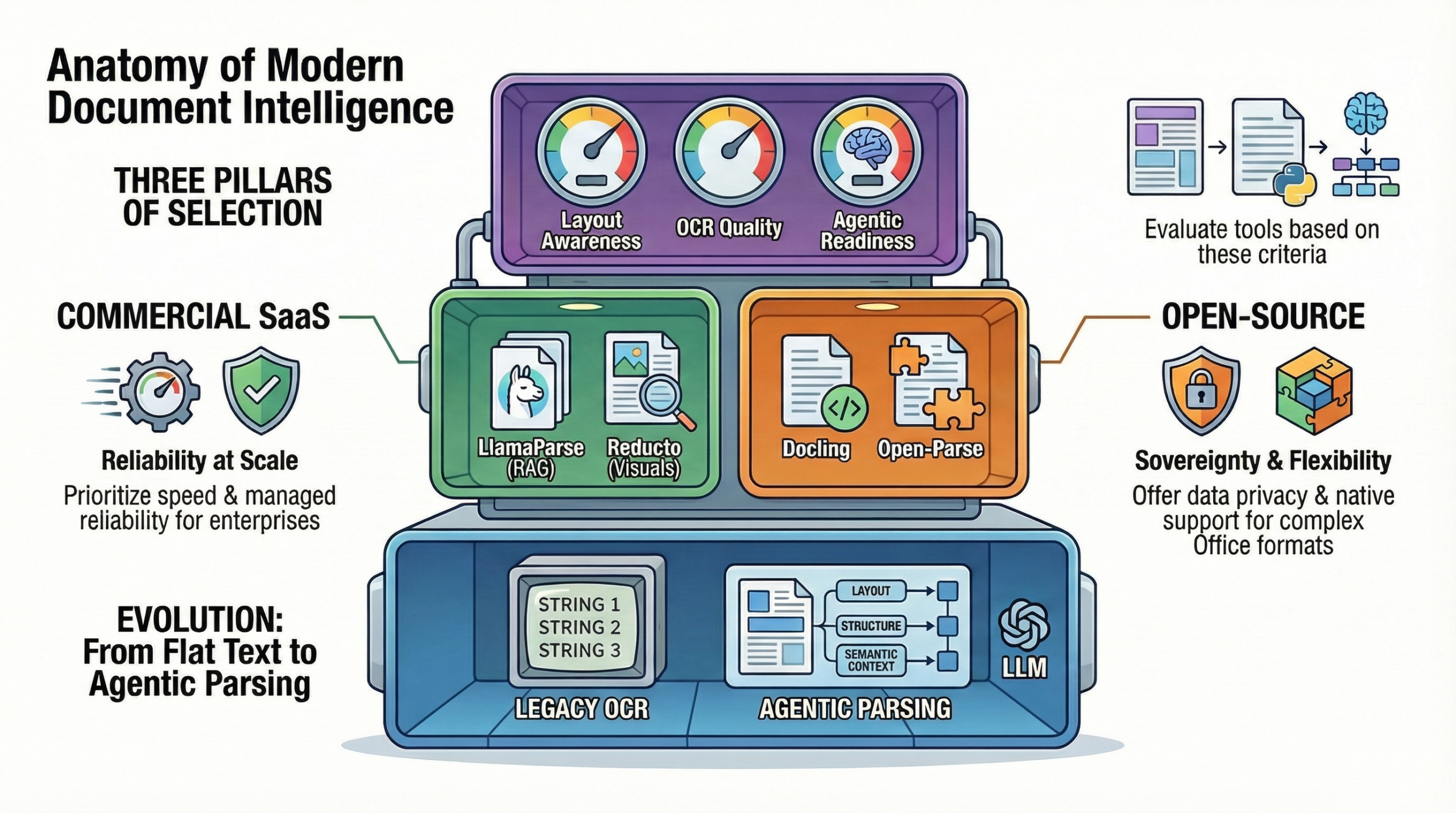
In the current era of enterprise AI, document extraction has evolved from a back-office utility into a cornerstone of the modern data architecture. The industry is witnessing a fundamental strategic pivot: the move from legacy Optical Character Recognition (OCR), which merely flattened images into text strings, to agentic, layout-aware parsing. This transition is critical for organizations aiming to unlock the 80% of enterprise data trapped in unstructured formats. Modern architectures no longer require just “text”; they demand semantic integrity, structural context, and the ability to feed high-fidelity data into Large Language Model (LLM) agents.
The scope of this report is to evaluate the prevailing extraction ecosystem, spanning both high-velocity commercial Managed-SaaS solutions and highly customizable open-source frameworks. This analysis is designed to facilitate high-stakes architectural decision-making by weighing operational overhead against technical control. I begin by examining the capabilities and market positioning of the commercial leaders currently defining the standard for managed document intelligence.
2. Commercial Platforms: Managed Solutions for Enterprise Reliability
Managed SaaS extraction tools help modern enterprises launch faster and reduce technical debt. They handle model maintenance, infrastructure scaling, and complex document edge cases. This allows architects and internal teams to focus on core business logic instead of managing technical complexity.
2.1 Market Positioning and Strategic Analysis
The commercial market is tiered based on specific architectural needs, ranging from RAG-optimized parsers to massive enterprise automation suites.
- Semantic and Layout Specialists: LlamaParse (by LlamaIndex) and Reducto represent the vanguard of context-aware extraction.
- LlamaParse is purpose-built for RAG pipelines, offering confidence scoring and traceability that are non-negotiable for auditable AI (Link).
- Reducto distinguishes itself through superior handling of visually complex elements like nested tables and figures, utilizing agentic error correction to ensure the visual structure is preserved in the output (Link).
2.2 The Enterprise “Big Three” and Integrated IDP:
- Google Document AI is the optimal choice for organizations requiring sophisticated AI/ML pre-trained processors and robust human-in-the-loop (HITL) validation workflows. (Link)
- Amazon Textract is the strategic standard for firms deeply embedded in the AWS ecosystem, offering smooth scalability and reliable form/table extraction without the need for bespoke model training. (Link)
- ABBYY (FlexiCapture/Vantage) serves as the high-stakes choice for legacy risk mitigation; its “So What?” lies in its ability to provide enterprise-grade stability for multi-decade document environments where failure is not an option. (Link)
2.3 Specialized and Regulated Workflow Leaders:
- UiPath Document Understanding is the logical selection for firms where extraction is a component of a larger Robotic Process Automation (RPA) stack. (Link)
- Hyperscience is the “gold standard” for regulated industries requiring extreme accuracy and high-volume processing where data integrity is a compliance mandate. (Link)
2.4 Transactional and Integrated Niche Leaders:
- Rossum and Nanonets dominate the transactional space (invoices/receipts). While Rossum focuses on supply chain intelligence (Link), Nanonets provides a unique “So What?” via its highly trainable, no-code/low-code pipelines that allow business users to iterate on extraction schemas. (Link)
- Lido offers a disruptive value proposition with template-free extraction and both API and no-code options, making it ideal for rapid prototyping. (Link)
- Mistral OCR integrates LLM understanding directly into the OCR process, allowing the system to use linguistic context to resolve ambiguities in scanned text. (Link)
- Tensorlake functions differently than a mere parser; it is an agentic workflow runtime that manages state and execution for schema-based extraction. (Link)
2.5 Overview of Commercial Tools
| Tool Name | Primary Strength | Best Use Case |
|---|---|---|
| LlamaParse | Semantic Traceability | RAG & context-heavy LLM pipelines |
| Reducto | Visual Layout Mastery | Complex PDFs with figures and tables |
| Google Document AI | Pre-trained ML Processors | Large-scale automated enterprise workflows |
| Amazon Textract | AWS Native Integration | High-volume standard form extraction |
| ABBYY | Mature IDP Stability | Legacy document automation & risk reduction |
| UiPath | RPA Ecosystem Integration | Document-heavy business process automation |
| Hyperscience | Extreme Accuracy | Highly regulated, high-volume workflows |
| Rossum / Nanonets | Transactional Specialization | Invoices and supply chain documents |
| Lido | No-Code Flexibility | Template-free rapid data extraction |
| Mistral OCR | LLM-Integrated Vision | Context-sensitive scanned text extraction |
| Tensorlake | Workflow Runtime | Agentic, schema-driven data ingestion |
While these managed solutions provide reliability, organizations seeking ultimate data sovereignty and customization often pivot toward the open-source ecosystem.
3. Open-Source Ecosystem: Flexibility, Privacy, and Customization
The strategic drivers for open-source adoption are rooted in data sovereignty, long-term cost control at scale, and the ability to build bespoke pipelines that commercial black-box models cannot support. For architects, open-source provides the transparency required to tune extraction for highly specific internal document types.
3.1 Evaluation of Open-Source Frameworks
ETL and Self-Hosted Platforms:
Visually Driven and Schema-Based Parsing:
The “Building Block” Approach:
- PyMuPDF + Tesseract for lightweight OCR pipelines. (Links: PyMuPDF, Tesseract)
- pdfplumber, python-docx, openpyxl for structured access. (Links: pdfplumber, python-docx, openpyxl)
- camelot and Table Transformer for table extraction
- document_ai_agents for full agentic pipelines (Link)
3.2 Technical Advantages of Open-Source
- Data Sovereignty: Sensitive data stays within your infrastructure
- Format Versatility: Tools like Docling support Office formats natively
- Bespoke Optimization: Swap components like camelot for precision
- Agentic Readiness: Frameworks like document_ai_agents enable rapid deployment
The choice between these frameworks is ultimately governed by three performance-critical pillars, which we analyze in the following section.
4. Comparative Technical Analysis: Layout, OCR, and Agentic Readiness
Architectural selection must be grounded in three technical benchmarks: Layout Awareness, OCR Quality, and Agentic Integration.
4.1 Layout Awareness
Layout awareness is the capacity to recognize spatial relationships. Tools like Reducto and Open-Parse treat documents visually.
4.2 OCR and Scanned Document Handling
Amazon Textract and Google Document AI provide strong OCR, while Mistral OCR adds context-aware interpretation.
4.3 Agentic Integration and Self-Correcting Pipelines
Agentic systems use feedback loops for correction. Tools like Tensorlake manage these workflows dynamically.
4.4 Architectural Recommendation: Feature Matrix
| Criterion | Best-in-Class Tools |
|---|---|
| Complex Visual Layouts | Reducto, LlamaParse, Open-Parse |
| Office Format Handling | Docling, python-docx, openpyxl |
| High-Accuracy Scanned OCR | Amazon Textract, Google Document AI, Mistral OCR |
| Self-Correcting Agentic Workflows | Tensorlake, LlamaParse, document_ai_agents |
| Regulated Workflow Accuracy | Hyperscience, ABBYY |
This technical foundation leads directly to a practical decision framework for organizational implementation.
5. Strategic Decision Framework and Practical Selection
Synthesizing this analysis requires a balance of organizational constraints, data sensitivity, and the desired level of engineering involvement.
5.1 Practical Short List for Initial Evaluation
For organizations initiating their document intelligence journey, start with these benchmarks:
- General Purpose Semantic: LlamaParse
- Visually Complex Documents: Reducto
- Open-Source / Office Native: Docling
- Enterprise / Cloud Native: Google Document AI or Amazon Textract
- Self-Hosted Workflow: Unstract
5.2 Decision Matrix
| Business Requirement | Recommended Commercial Starting Point | Recommended Open-Source Starting Point |
|---|---|---|
| Need for Self-Hosting | N/A | Unstract or Docling |
| Invoices / Transactional | Rossum or Nanonets | LangChain Extraction Service |
| Complex Nested Tables | Reducto or LlamaParse | Open-Parse or camelot |
| High Volume / Regulated | Hyperscience or Google Doc AI | Docling (within private infra) |
| Agentic Workflow Runtime | Tensorlake | document_ai_agents |
| RPA Integration | UiPath Document Understanding |
6. Conclusion
The “Build vs. Buy” trade-off is increasingly nuanced. A “Buy” strategy with a tool minimizes time-to-value and risk. Conversely, a “Build” strategy offers long-term cost efficiency and total data sovereignty.
Many elite architectures now adopt a hybrid approach, for example, using Amazon Textract for high-volume raw OCR and Docling or Open-Parse for visual reconstruction and format-specific extraction.
For those seeking deeper technical benchmarks and developer-focused comparisons, external resources like the ACL Anthology and the DEV Community provide additional research on the latest AI document parsing advancements.
In the future, I will share more details on how, where, and when to use these tools, along with practical implementation guidance. Feel free to reach out if you have research ideas—I’d be happy to collaborate.
References
Commercial Platforms: LlamaParse, Reducto, Google Document AI, Amazon Textract, ABBYY, UiPath, Hyperscience, Rossum, Nanonets, Lido, Mistral OCR, Tensorlake.
Open-Source Frameworks: Unstract, Docling, Open-Parse, LangChain, PyMuPDF, Tesseract, pdfplumber, python-docx, openpyxl, document_ai_agents.